GDPR and Your Instagram Data: 4 Privacy Rights You Should Use
Want to see who isn't following you back right now?
Use our safe Instagram unfollower checker — no login needed. Upload your official Instagram data export and get instant results.
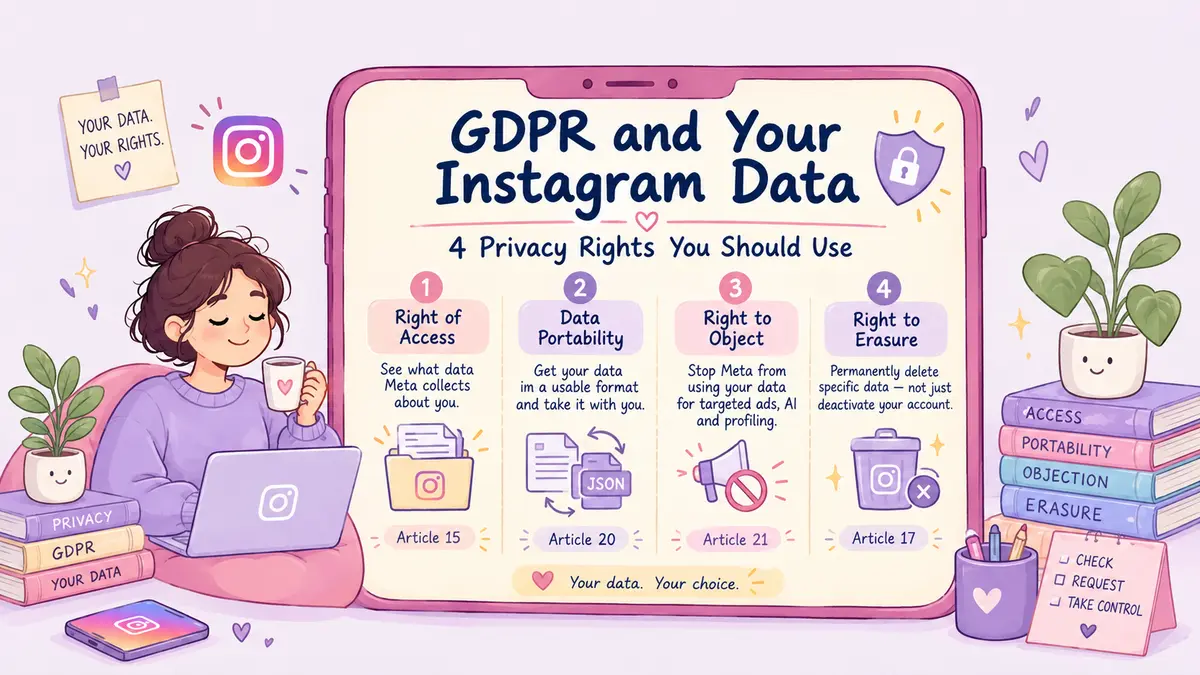
Most people interact with data privacy regulations purely through cookie consent banners and revised terms of service popups. If you reside in the United Kingdom or the European Economic Area, the General Data Protection Regulation (GDPR) and the UK Data Protection Act provide you with legally enforceable rights over your personal data held by Meta. Yet the vast majority of Instagram users never venture beyond the standard in-app settings menu.
Understanding your statutory rights under European privacy law shifts how you interact with the platform. Rather than treating Instagram as a closed environment where Meta dictates the terms of access, European data protection law provides specific legal mechanisms to inspect, extract, challenge, and permanently purge the records collected on your account.
The Right of Access: Auditing Meta's Hidden Telemetry
Article 15 of the GDPR establishes your right of access. While most account holders assume this simply means viewing their public profile or scrolling back through direct messages, the scope of Article 15 is far broader. It gives you the legal right to obtain confirmation as to whether your personal data is being processed, why it is being processed, and precisely what data categories Meta retains across its systems.
When you request your raw gdpr instagram data package, you receive information that is entirely invisible within the standard user interface. The raw export files contain deep background telemetry:
- Inferred interests and behavioural clusters used for targeted advertising.
- Historical records of every profile search, hashtag lookup, and visited profile.
- Granular interaction timestamps for every like, comment, saved post, and story view.
- Off-platform activity captured by Meta Pixel trackers on third-party retail and news websites.
- Device telemetry, including operating system builds, hardware identifiers, and IP connection logs.
- Contact books uploaded from mobile devices during account setup or contact syncing.
Reviewing this data gives you an objective view of the behavioural profile Instagram builds around your activity. Under Article 15, you have the right to receive this full dataset free of charge and within thirty days.
Data Portability: Taking True Ownership of Your Graph
Article 20 of the GDPR guarantees your right to data portability. Under this provision, you are entitled to receive your personal data in a structured, commonly used, and machine-readable format—such as JSON or HTML—and transmit that information to another platform or tool without interference.
This right is vital for understanding your social graph, specifically your follower lists, following lists, and direct message histories. The native Instagram application restricts how you view these relationships. It does not provide historical records of who has unfollowed you, nor does it allow you to filter mutual connections efficiently without third-party assistance.
Historically, users compromised their security by giving their login credentials to questionable third-party mobile applications that scraped connection data through unofficial APIs. Handing over your username and password creates severe security risks, including account suspensions and credential theft. The GDPR portability framework eliminates this problem by allowing offline, local analysis. For example, ByeBud processes your official data export locally within your browser, ensuring no account passwords or raw personal data are transmitted to external servers. Exercising your Article 20 rights allows you to audit your network securely under your own control.
The Right to Object: Restricting Legitimate Interest Processing
Article 21 grants you the right to object to the processing of your personal data when Meta relies on "legitimate interests" as its legal basis, rather than explicit consent or contractual necessity. Over recent years, regulatory decisions by European data protection authorities have restricted Meta from relying on contractual necessity for behavioral advertising and AI model training, forcing the company to rely on legitimate interest frameworks.
This distinction is critical for users. When data processing is based on legitimate interest, you have a statutory right to object at any time. Adjusting marketing preferences in the mobile app does not exercise this right; it merely toggles surface-level ad personalisation.
Submitting a formal Article 21 objection forces Meta to cease processing your data for these activities unless they can demonstrate compelling legitimate grounds that override your fundamental privacy rights. This right applies directly to:
- Training Meta's generative artificial intelligence models on your public posts, images, and captions.
- Cross-platform tracking through external software development kits (SDKs) and web trackers.
- Psychographic profiling used to predict your spending habits, political leanings, and emotional states.
To exercise this right, European and British users must submit Meta's specific GDPR Objection Form, which is located inside the platform's European Privacy Centre.
The Right to Erasure: Beyond Basic Account Deactivation
Article 17 defines the right to erasure, commonly referred to as the "right to be forgotten". Many users mistakenly equate account deactivation with data erasure. When you deactivate an account, Meta retains all your profile data, media files, and interaction logs on active servers, ready for immediate restoration if you log back in.
Even when you select the standard account deletion option within the app, Meta maintains database backups and log records for up to 90 days before initiating physical deletion.
A formal Article 17 request enables targeted erasure without necessarily terminating your entire account. Under this article, you can instruct Meta to permanently purge specific categories of historical data, including:
- Imported address books and phone numbers scraped from previous device syncs.
- Historical location records and precise GPS coordinate histories.
- Outdated search queries and profile interaction logs.
- Archived direct messages and media stored on Meta's staging servers.
Furthermore, Article 17 requires Meta to notify third-party service providers and data brokers who received your information to delete all downstream copies.
How to Exercise Your Rights with Meta's Data Protection Officer
When you want to enforce these rights beyond automated exports, dealing with standard customer support channels is rarely effective. You must communicate directly with Meta's Data Protection Officer (DPO).
- Locate the DPO Contact Form: Meta provides a dedicated legal contact form within the Instagram Help Centre and Privacy Policy sections for UK and EEA users.
- Specify the Statutory Article: Explicitly cite the GDPR article you are invoking (such as Article 15 for Access, Article 17 for Erasure, or Article 21 for Objection).
- Define Your Request Narrowly: Clearly identify the exact data categories, timestamps, or processing activities you want addressed to prevent administrative delays.
- Track the Legal Response Timeline: Meta must respond within one calendar month. While complex requests may allow a two-month extension, Meta must notify you of the delay within the initial 30 days.
If Meta ignores your request or issues an unlawful refusal, you can escalate the matter directly to your national data protection regulator, such as the Information Commissioner's Office (ICO) in the UK or the Data Protection Commission (DPC) in Ireland.
Understanding your gdpr instagram data rights empowers you to manage your presence on Meta's platforms intentionally. By using the statutory tools provided by European law, you take charge of your personal data rather than letting corporate algorithms dictate how your information is used.
Want to see who isn't following you back right now?
Use our safe Instagram unfollower checker — no login needed. Upload your official Instagram data export and get instant results.
Related articles
- 5 Content Changes to Test After Your Instagram AuditA profile audit shows where you lose audience attention. Here is a five-step testing plan to refine hooks, carousels, and stories for better retention.
- The Math Behind Rising Engagement Rates as Followers DropLosing followers can actually improve your performance metrics. Here is the mathematical formula behind rising engagement rates and why a smaller audience often boosts distribution.
- What to Do If You Gave Your Password to an Instagram AppIf you gave your password to an unfollower tracker or third-party app, act fast. Here are the exact damage-control steps to secure your Instagram account right now.
- How to Calculate Real Instagram Engagement From Your Data ExportLearn how to calculate your real Instagram engagement rate directly from your raw data export files using a precise formula and weighted interaction metrics.
- When an Instagram Audit Is a Complete Waste of Your TimeAuditing your Instagram audience sounds responsible, but doing it too early or too often is pure procrastination. Here is when an audit is a waste of time and what actually moves the needle.